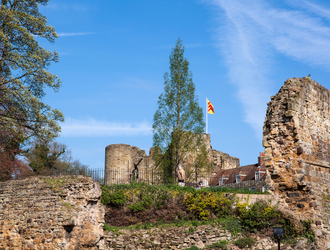
History of the Castle
Early history
Opening of the castle to the public
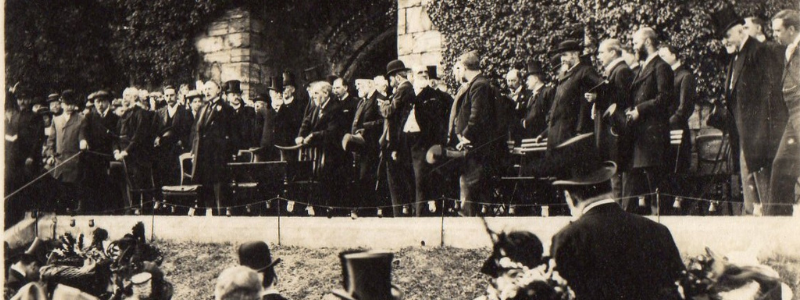
In 1897 Queen Victoria celebrated her Diamond Jubilee. Councils across the country wanted to mark the occasion with permanent memorials. This included Tonbridge Urban District Council who looked around for a suitable tribute. Many ideas were discussed before they agreed that the most fitting would be the purchase Tonbridge Castle and grounds.
On Wednesday 23 May 1900, shortly after 2pm, Earl Stanhope, Lord-Lieutenant of Kent, arrived at the entrance to the castle. William Baldwin, chairman of the council, handed him a small silver key. Written on the key was the inscription “Salus populi suprema lex” – the health of the people is the highest law. A large crowd had gathered that day to witness this important moment in the town’s history. As Earl Stanhope unlocked the gate, a cheer went up. The castle which had so long dominated the town now belonged to the people of Tonbridge.
Castle origins
The relationship between the town and the castle had not always been so harmonious. 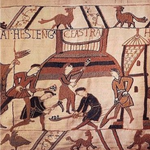 A motte and bailey type, the Normans introduced these castles to England after 1066. Invading armies expect local resistance, and William the Conqueror's was no exception. To secure their position, the Normans needed to build fortresses. This was the main advantage of the motte and bailey. Constructed in wood and placed on top of earthworks, they were quick and cheap to create. As they towered over towns, their purpose was clear. To control rather than protect the local community. Castles soon became a feature of the English landscape. In fact, they were so common they feature in the Bayeaux Tapestry. These forts had many uses. During times of war, they were garrisons and strongholds. They also provided residences for aristocrats who used them for local administration.
The Normans choose Tonbridge as a place of fortification because of its location. Looking over the river Medway, it guarded the road from Hastings to London. We first hear about our castle in 1088. Yet, it is likely that Richard FitzGilbert built it soon after the invasion of 1066.
Castle destruction
Richard had been a long time loyal supporter of William the Conqueror. In return for his loyalty, he received large parts of Kent and Suffolk. This included Tonbridge as well as his holding in Clare, Suffolk, from which he later took his name.
Now known as de Clare, Richard rebelled against William's son, Rufus, after the Conqueror's death in 1088. In a show of strength, Rufus besieged Tonbridge Castle for two days. When the castle fell, Rufus ordered its destruction along with the town. The de Clares subsequently accepted Rufus' reign and the castle was restored to them. It is likely that shortly after that, they started to fortify the site with a stone keep.
As time passed, the de Clares became one of the most influential families in England. They were present at the signing of the Magna Carta and when King John resiled on his promises, they took arms against him. In November 1215, Tonbridge Castle was once again besieged and taken.
The castle came back into the hands of the de Clare family during the reign of Henry III. In 1253, Henry gave Richard the licence to wall and embattle Tonbridge. Building work started and by 1259, the de Clares had largely built the castle as it stands today.
Creation of parliament
In 1261 the de Clares rebelled again. Joining with Simon de Montford, they wanted to limit the powers of the king. War raged across England and Tonbridge Castle fell once again. Yet by 1264, this rebellion succeeded. The barons defeated the king's forces at the Battle of Lewes and this changed England. Parliament was now to include commoners, elected by property owners. This was a crucial step in the development of parliamentary democracy.
By the early 14th century, the de Clare line died out. The castle passed to the Staffords, noble servants of the crown, where it was to remain for several years. Yet, in 1520 Henry VIII found Edward Stafford, Duke of Buckingham guilty of treason. After his execution, Henry took possession of the castle, and gifted it to his noble friends.
The civil war
In 1600, Thomas Weller bought the castle. A staunch Parliamentarian, he was resident when civil war broke out in 1642. The war centred around the powers of the king. Cavaliers fought for Charles I against the Roundheads, whose loyalty lay with parliament. In the end the parliament was victorious. Unlike many other castles in England, Tonbridge had not sustained substantial damage. Yet, the end of the war saw its demise. An act of parliament demanded the dismantling of its defenses. The castle was not to see active war again.
More in this section