History of Tonbridge

Early history
Tonbridge is a market town in the county of Kent. First mentioned in the Doomsday book it was a relatively large settlement with 25 villagers, nine smallholders and seven slaves. At that time, the town was known as Tonebriga. This perhaps refers to the many bridges built over the Medway at the time.
Because of its position on the route from Hastings to London, the town was of strategic importance. As such, in 1259 Henry III granted a licence to allow the town to be walled and embattled. Although none of this wall remains, part of the ditch, known as the Fosse, can still be traced. Rights of way route MU52 allows you to walk part of the route. Search Public rights of way map.
Historic buildings
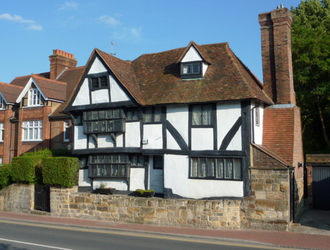
Many medieval buildings still survive in the town. The oldest of these is believed to be the Port Reeve’s house on East Street. Built in the 15th century using local materials, it has a timber frame. Records suggest that it was bomb damaged during WW2, but is now fully restored. In the Georgian period, brick buildings were more fashionable so many of the buildings along the High Street were refronted. This was believed to give them a more modern feel. A good example of this is the Rose and Crown Inn. You can find out more about Tonbridge’s historic buildings at Tonbridge conservation area appraisals.
Town growth
From the 1740s, travelling into Tonbridge became easier. Starting with improvements to the river Medway, transportation was made easier still by the arrival of the railway in 1842. This allowed the town to grow significantly. A larger population meant over-crowded living conditions. As a result, there were two serious outbreaks of cholera in the town in 1849 and 1854.
Despite this, Tonbridge continued to thrive, and industry grew as a result. Perhaps the best known was Tunbridge Ware manufacturing. This is decorative inlaid woodwork, most usually in box form and is still much sought after today.
A connection to Jane Austen
Although Jane Austen herself was born in Hampshire, her father, George had many links to Tonbridge. George was born in Tonbridge and both attended and taught at Tonbridge School. To find out more, enjoy a short circular walk to Tonbridge.